Overview
On the evening of June 20, 2025, and into the early morning hours of June 21, 2025, a significant severe weather outbreak impacted southeast North Dakota. The event was characterized by the development of supercell thunderstorms that produced multiple tornadoes, including a violent EF5, followed by a powerful derecho that brought widespread straight-line wind damage across the region. The episode resulted in three direct fatalities and caused extensive agricultural damage, with state officials estimating a loss of 50 to 80 million bushels of grain storage capacity.
Environmental Context
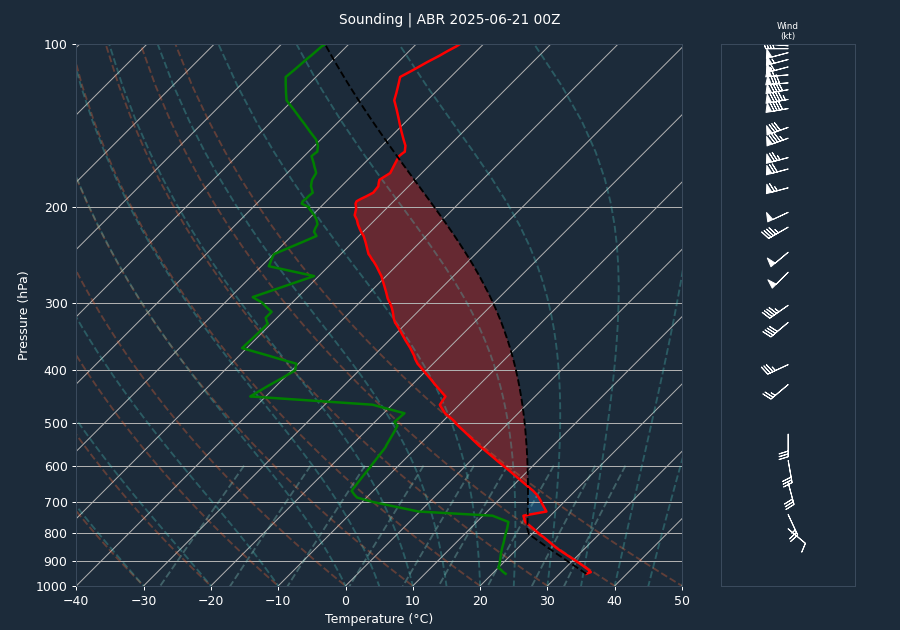
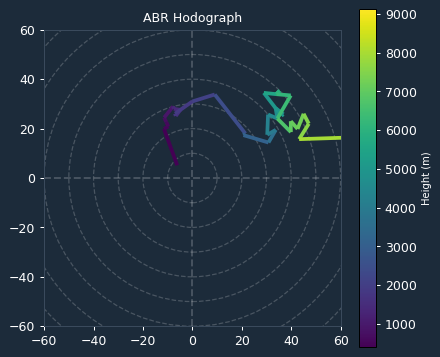
The atmospheric environment was highly primed for severe weather. A pre-event sounding from Aberdeen, South Dakota, indicated extreme instability with a CAPE value of 4692 J/kg and a CIN of -41 J/kg, suggesting a volatile atmosphere with minimal inhibition for convective initiation. The 0-6km bulk shear of 49 knots provided a favorable environment for supercell development.
Kinematic data derived from the VAD wind profile at the time of the event further highlighted the potential for tornadogenesis. The 0-1km Storm Relative Helicity (SRH) was 186 m²/s², while the 0-3km SRH reached 347 m²/s². These significant SRH values indicate strong low-level wind shear, which played a critical role in supporting mesocyclone development and the production of intense, long-track tornadoes.
Storm Evolution
Radar analysis from KMVX tracked the evolution of the supercell storms. Throughout the event, maximum reflectivity values frequently exceeded 67 dBZ. A notable trend in the radar data was the descent of the high-reflectivity core; for instance, the height of maximum reflectivity dropped from 19.9 kft at 04:27:42 UTC to 4.8 kft by 04:20:49 UTC, often signaling the intensification of the storm's low-level structure. Inbound and outbound velocities consistently reached 65.1 knots, which represented the effective measurement limit (Nyquist) of the radar, indicating intense rotation within the storm's core.
Warnings Issued
A total of 10 warnings were issued by the National Weather Service in Grand Forks (FGF) to address the evolving threat. These included multiple tornado warnings and severe thunderstorm warnings as the system transitioned from discrete supercells to a derecho.
Warning effectiveness was high, particularly regarding the most significant tornado of the event. The first tornado warning for the Enderlin area was issued at 03:42:00 UTC, providing 22 minutes of lead time before the EF5 tornado touched down at 04:04:00 UTC. This lead time significantly exceeded the national average of approximately 13 minutes, providing critical time for public awareness.
Impacts
The event produced 17 verified tornado records across the region. The most destructive was the Enderlin #1 tornado, which tracked 12.097 miles with a maximum width of 1850 yards. This EF5 tornado resulted in three direct fatalities. Forensic analysis of a train derailment south of Highway 46, where 33 train cars were tipped or lofted, confirmed wind speeds exceeding 210 mph. The tornado caused catastrophic damage to multiple farmsteads, including leveled homes and debarked trees.
Other significant tornadoes included an EF3 in Barnes County that destroyed metal buildings and lofted vehicles, and an EF2 near Valley City that caused extensive structural damage. In addition to the tornadoes, the subsequent derecho produced widespread straight-line wind damage. Notable wind gusts included 111 mph near Luverne, 99 mph near Galesburg, and 95 mph near Dazey. The combination of these events led to widespread destruction of grain storage facilities and infrastructure across Barnes, Cass, Ransom, and Steele counties.
Conclusion
The June 20-21, 2025, severe weather event was a historic episode for southeast North Dakota. The combination of extreme instability and significant low-level shear facilitated the production of violent tornadoes, including an EF5, followed by a destructive derecho. While the event resulted in three fatalities, the effective warning lead times provided by the National Weather Service were instrumental in the public response during this high-impact weather scenario.