Overview
On April 23, 2026, a significant severe weather event impacted Garfield County, Oklahoma, resulting in multiple tornadoes and severe wind reports. The most notable feature of this event was an EF4 tornado that tracked through the Enid area. Damage surveys conducted by the National Weather Service confirmed a total of four distinct tornado tracks associated with this system, including three smaller tornadoes in the Braman area and the major event in Enid.
Environmental Context
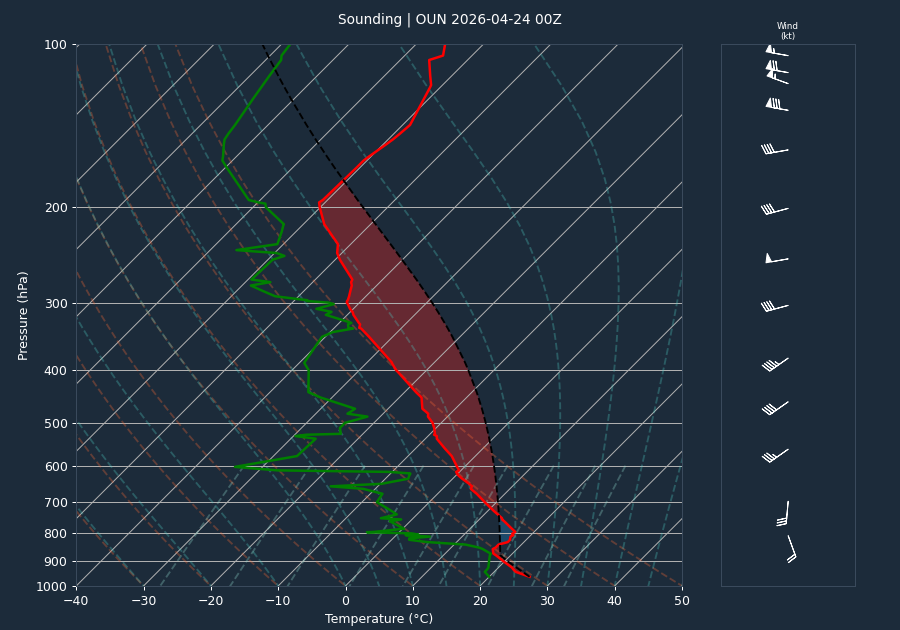
The atmospheric environment leading up to the event was highly favorable for supercell development and intense tornadic activity. The pre-event sounding from OUN at 00:00 UTC indicated significant instability, with a CAPE value of 3514 J/kg and a CIN of 0 J/kg, suggesting that the atmosphere was primed for convective initiation with no significant capping. Furthermore, the 0-6km bulk shear was measured at 49 knots, a value supportive of organized supercell structures.
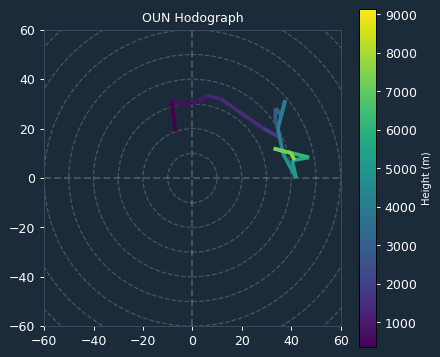
Kinematic data derived from the VAD wind profile at the time of the event further highlighted the potential for rotation. The 0-1km Storm Relative Helicity (SRH) was 211 m²/s², while the 0-3km SRH reached 307 m²/s². These values indicate a significant potential for mesocyclone development and sustained tornadic rotation, providing the necessary low-level shear to support the intensity observed during the Enid tornado.
Storm Evolution
Radar analysis from KVNX captured the intensification of the storm system. Throughout the event, the radar consistently measured inbound and outbound velocities of 64.1 knots, indicating that the velocity field reached the radar's effective measurement limit (Nyquist). Reflectivity values remained high, frequently exceeding 70 dBZ, with a peak of 74.0 dBZ recorded at 01:04 UTC and again at 01:49 UTC. Echo tops were consistently high, with 18 dBZ tops reaching up to 68.5 kft, reflecting a robust and deep updraft. Fluctuations in the height of the maximum reflectivity core, such as the descent observed between 01:17 UTC and 01:23 UTC, were consistent with the evolution of the storm's internal structure during the period of peak intensity.
Warnings Issued
A total of four warnings were issued by the National Weather Service office in Norman (OUN) to address the evolving threat. This included two Severe Thunderstorm Warnings and two Tornado Warnings. The first Tornado Warning (OUN.TO.W.0036) was issued at 00:59 UTC on April 24, 2026.
Regarding warning effectiveness, the first tornado warning provided 12 minutes of lead time before the EF4 tornado touched down at 01:11 UTC. This lead time is slightly below the national average of approximately 13 minutes, but it provided critical time for public notification ahead of the highest-rated tornado of the event.
Impacts
The damage survey results, as authorized by the NWS, categorize the impacts as follows:
- Enid Tornado: Rated EF4, with a path length of 9.5107 miles and a maximum width of 600 yards. This tornado produced winds estimated at 180 mph and resulted in 1 injury.
- Braman Tornado: Rated EF1, with a path length of 10.3859 miles and a maximum width of 400 yards. Maximum winds were estimated at 110 mph.
- Braman Satellite 1: Rated EF0, with a path length of 0.4444 miles.
- Braman Satellite 2: Rated EF0, with a path length of 2.931 miles and a maximum width of 50 yards.
Additional local storm reports included a 107 mph thunderstorm wind gust at Vance Air Force Base at 01:11 UTC, and a 65 mph wind gust accompanied by 2.75-inch hail near Douglas at 02:35 UTC. A report of 1.75-inch hail was also received from Noble County at 03:20 UTC. Across all surveyed tracks, there were 0 fatalities and 1 total injury reported.
Conclusion
The April 23, 2026, event was characterized by a high-instability environment that supported a violent EF4 tornado in Enid. While the event produced significant structural damage, the timely issuance of tornado warnings provided necessary lead time for the public. The combination of high CAPE and significant SRH values created a volatile environment that manifested in the intense tornadic activity observed throughout the night.