Overview
On May 21, 2024, a significant severe weather outbreak impacted central and southwestern Iowa, characterized by multiple rounds of thunderstorms that produced damaging winds, large hail, and a series of destructive tornadoes. The most severe event of the day was a violent, long-track tornado that struck the town of Greenfield in Adair County. This outbreak resulted in 5 fatalities and 35 injuries, with a total of 10 confirmed tornadoes across the region. The event was part of a larger episode that included widespread flash flooding and wind damage across the forecast area.
Environmental Context
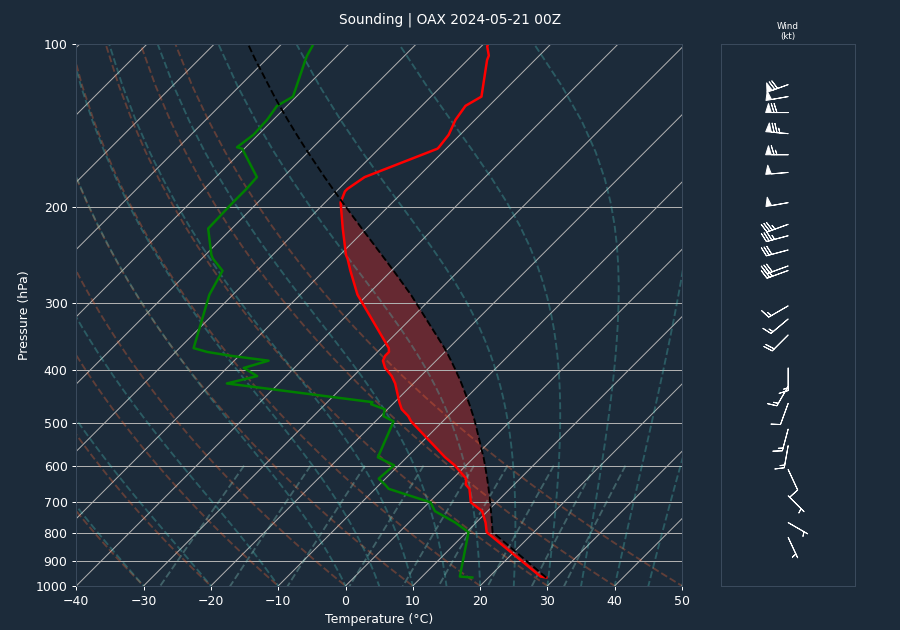
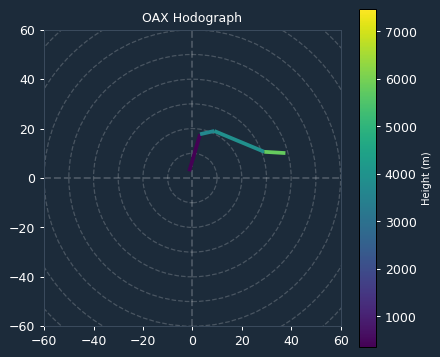
The atmospheric environment leading up to the event was characterized by moderate instability and sufficient shear to support supercell development. The 00:00 UTC sounding from OAX indicated a CAPE of 2645 J/kg, suggesting significant potential for convective development, with a CIN value of 0 J/kg, which facilitated easy convective initiation. The 0-6km bulk shear was measured at 31 knots, placing the environment in a range favorable for supercell formation.
Kinematic data derived from the VAD wind profile at the time of the event showed a 0-1km Storm Relative Helicity (SRH) of 17 m²/s² and a 0-3km SRH of 50 m²/s². These values are relatively low, suggesting that while the thermodynamic environment was highly unstable, the low-level kinematic support for mesocyclone development was modest. It should be noted that the sounding and VAD profiles may under-sample the specific inflow environment of the storms, particularly given the complex evolution of the cold front and the preceding morning's heavy rainfall.
Storm Evolution
Radar analysis from KDMX revealed a highly intense convective system. Throughout the event, the radar consistently recorded maximum inbound and outbound velocities of 69 knots. Because these values remained identical and repeating across multiple scans, it is highly probable that the mesocyclone intensity exceeded the radar's maximum unambiguous velocity threshold (the Nyquist limit), indicating that actual rotational winds were significantly higher than the instrument could natively measure.
The storm exhibited a persistent, intense core, with maximum reflectivity values frequently exceeding 70 dBZ. Notably, echo tops reached as high as 69.9 kft at 20:44 UTC, indicating a powerful, sustained updraft. The descent of high-reflectivity cores, observed alongside spikes in reflectivity height, suggests the presence of large hail and intense precipitation loading within the storm structure during its most violent phases.
Warnings Issued
A total of 10 warnings were issued by the National Weather Service (WFO DMX) during the event, including 9 Tornado Warnings and 1 Severe Thunderstorm Warning. The warning operations were highly effective, particularly regarding the Greenfield tornado. The first tornado warning for the storm system was issued at 19:55:00 UTC, providing a lead time of 32 minutes before the EF4 tornado touched down at 20:27:00 UTC. This lead time significantly exceeded the national average of approximately 13 minutes, providing critical time for public response.
Impacts
The outbreak caused extensive damage across multiple counties. The Greenfield tornado, rated EF4, tracked 43.07 miles with a maximum width of 1600 yards. It caused 5 fatalities and 35 injuries in Adair County, with property damage estimated at $30,000,000. The tornado produced widespread destruction in Greenfield, particularly between SW 3rd Street and SE 3rd Street, where multiple homes were completely destroyed. A Doppler on Wheels (DOW) research team reportedly measured wind speeds of over 300 mph approximately 150 feet above ground level during this event.
Other notable impacts included:
- Adams County: An EF3 tornado tracked 24.78 miles, resulting in 1 fatality and $1,800,000 in property damage. The tornado caused widespread destruction to farmsteads, industrial wind turbines, and power infrastructure.
- Adair County: In addition to the EF4, an EF2 tornado tracked 14.63 miles, causing $750,000 in damage to farmsteads and wind energy infrastructure.
- General Impacts: Across the region, numerous reports of 3-inch tree limbs broken, power pole damage, and hail ranging from penny to half-dollar size were documented. Flash flooding was also reported in Union County.
Conclusion
The May 21, 2024, outbreak was a high-impact event driven by a volatile thermodynamic environment. While the kinematic profile appeared modest, the resulting storms were capable of producing violent, long-track tornadoes. The significant lead time provided by the NWS warning system was a critical factor in the response to this event, though the intensity of the Greenfield tornado resulted in tragic loss of life and extensive structural devastation.